
Europe Day is celebrated on the 9th of May, as the anniversary of the day when the Schuman’s visionary declaration was written in 1950. It enabled better cooperation in post-war Europe. At that time, they proposed the establishment of the European Coal and Steel Community. In 1993 the European Union emerged from this special form of internal cooperation. French foreign minister Robert Schuman was of the opinion that a united Europe will certainly not be created immediately, but that it will be a long-term process that will not only be supported by one plan, but by many solid successes that are a prerequisite for solidarity.
The basic building blocks of the European Union are European values such as unity, diversity, peace, democracy, respect for human rights and the rule of law, mutual support and cooperation, the European social and educational model and the most advanced standards of protecting the environment and climate.
Europe Day also reminds us that even the European Union which is one of the most advanced and democratic associations of countries in the world has been affected by many crises. Europe may be one of the best places in the world to live but Schuman’s vision has not yet been realized. We have not yet achieved peace in Europe. A brutal war has been going on in Ukraine for the second year.
As a response to the Europe needs a thorough renovation is necessary to keep a united, peaceful and prosperous Europe in the future. The initiative for the New European Renaissance came from a group of Slovenian social scientists and humanists, for whom a visionary contribution was prepared by the Slovenian philosopher, writer and alpinist Dr Igor Škamperle from the University of Ljubljana.
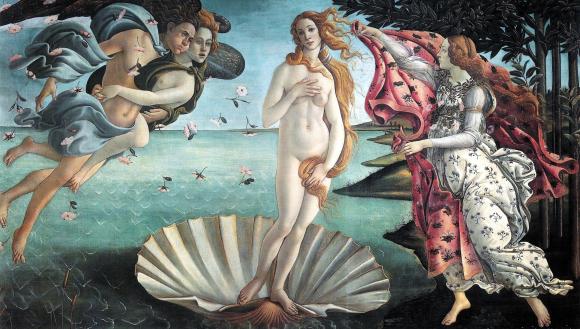
Dr Igor Škamperle compares the time of the Renaissance with today’s global situation. The Renaissance, he notes, emerged in medieval Europe at a time of hardship, war, famine, poverty and great uncertainty about the future. Amidst the fear of decline, the Renaissance, he says, brought light into the darkness and instead showed a way of transformation and renewal. At the heart of the Renaissance was a new image of people who are capable not only of falling, but also of rising to new levels. This image of light and hope brought a fresh energy to Europe that unlocked new worlds of ideas and imagination.
He argues that today, in the midst of a combination of global crises, when our physical powers are now at the level of natural forces and can cause great damage to our environment and ourselves, we must take responsibility for the situation and try to think our way out. Reviving the Renaissance image of human potential for ascension and respect for one’s fellow man at the heart of all aspects of society provides a way to escape current patterns of thought and open up new approaches to solving the crises of our time.
The following points were written by Dr Igor Škamperle and edited by the physicist and writer Dr Howie Firth:
1.) The world today faces a combination of crises – environmental damage, an economic crash, the risk of nuclear weapons, and rising levels of poverty and anger. Our physical powers are on the scale of a force of nature, capable of massive damage to our environment and ourselves. We have to take responsibility for the situation and try to think our way out of it. We feel ourselves locked into a complex situation by complex patterns. Globally, we are all connected by a common destiny on our planet Earth and there are no “other” lands to escape to. We have to stand and face the challenge and find solutions.
2.) One image that haunts us comes from Spengler in The Decline of the West, one hundred years ago – the image of cultures and civilisations as living organisms, with a bright youth, confident maturity and then old age and terminal decline and eventual replacement by some new young rival; and this, Spengler argued, would be the fate of the West. But looking into the past, there have also been situations when cultures in Europe came through difficult and critical moments by creating conditions for positive renewal, and then moved forward to a higher level of living. The historical periods of Europe, from antiquity to the modern era, are a collection of such transformations. A look at European history shows us that crises in society are often accompanied by crises in thought, from Socratic Athens to the collapse of the Roman Empire at the time of St. Augustine, and on to modern times. Each such crisis required critical self-examination; and this led in turn to transformation.
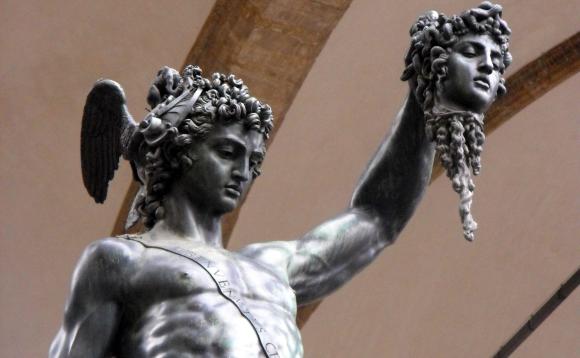
3.) The Renaissance came at a time of darkness and despair. Its light and exultation can sometimes lead us to forget that it emerged not as a natural progression out of happy times, but as a light in the darkness. Medieval Europe was ravaged by war, harsh winters that destroyed harvest and led to starvation, and terrible diseases like the Black Death and the plague. There was also a time of uncertainty in thought, with irony and human criticism appearing on the horizon of literary and philosophical thought as an expansion of the horizon of human understanding. We find in the work of thinkers like Lorenzo Valla, Alberti, Erasmus of Rotterdam and Sebastian Brandt, a deeply felt state of uncertainty. That feeling is there not only because of epidemics, ideological and religious conflicts, and deficient social conditions, but also extends to uncertainty about life and the future as such. The artistic expression of this feeling is the well-known motif of the Danse Macabre, the ‘dance of death’, with its inner conceptual essence the awareness that human life on Earth is not only in the hands of fate or divine providence, but largely depends on the – arbitrary – moves of nature and the decisions of man.
4.) In contrast to that bleak worldview, of humans powerless amidst the forces of nature and authority, the Renaissance, and then the Enlightenment and Romanticism that followed, emphasised the ‘miracle’ of a human being. The goal for each of us is not to become another and different being, but rather achieve the perfection of our own nature. The core of Humanism and the era of the Renaissance, with their otherwise ‘unfinished morning’, is to inspire and encourage us, so that we can look at human and human history, and at our Earth and the natural world, favourably and positively, with joy and an open expectation of the future. This does not negate the scepticism and awareness of an uncertain future, which were first brought to awareness in the clearest form by the period of Renaissance humanism; but it faces it with responsibility and determination and ultimately hope. Precisely because we are aware that the history of humanity lies in our hands, we are obliged to take care of the reality of this (our) world. Optimism and scepticism are two sides of the same face, seeing things as they are.
5.) Today we are similarly faced with a crisis in the world and a crisis in thought. Among the characteristics of Western thought today is nihilism, the belief that life is meaningless, that nothing in the world has a real existence. It means the dominance of a world in which physical objects rather than mind form reality, a world shaped by technology rather than mind or Nature, a world with the rejection of all moral principles. The example of the Renaissance suggests that what is called for is not some particular ideological or political instructions to tackle some particular aspect of the whole situation; but rather a complete change in our fundamental mindset. Instead of putting the machine first, with humans as cogs within it, we should shift focus to put humans first and foremost. At the centre of our new way of thinking should be a human being as an individual personal integrity, in a dynamic and responsible relationship with the natural environment and its creatures.
6.) But how to connect the values of humans in the mass, with democracy and human rights, with the natural world – and to do so with a holistic ecological awareness and solving ecological problems? We do so through the awareness that the Earth is the common home of all people. The new factor of our time is that with technological development, the entire natural world and living environment have become part of human ethical and moral responsibility. A human being is no longer in the position of neutrally exploiting natural resources and moving on; but recognising that we live in a shared environment in which we have to be actively and ethically responsible for the entire biosphere. The focus has shifted from that Spengler’s picture of the primacy of cultures and civilisations as organisms, going through times of growth and decline, to instead the world as a single common homeland that has at its centre a human individual, a citizen of the world, who is at the same time a transcendent being, striving for meaning, and choosing a way amongst different paths.
7.) The Renaissance thinker Pico della Mirandola, in his treatise on the dignity of man, wrote about the fact that a human being does not have a predetermined nature, nor a goal and meaning of their existence. Instead we each have the free possibility to choose and build it ourselves. This is precisely the foundation of human freedom and dignity. All of us have to become deeply aware of this today, and all of us have to accept that this is precisely the criterion that makes us human: that we are not a means to achieve some other goals in some technical or operational setting, but we are the the goal in itself, the goal of the full realisation of our own existence. In our present conditions, seen by the financial world as economic units, by biochemical research as a mass of complex chemical reactions, and by the development of artificial intelligence as a computer system eventually to be improved on, that principle from more than five centuries ago, of human choice and potential, is at the heart of the direction in which we have to go today.
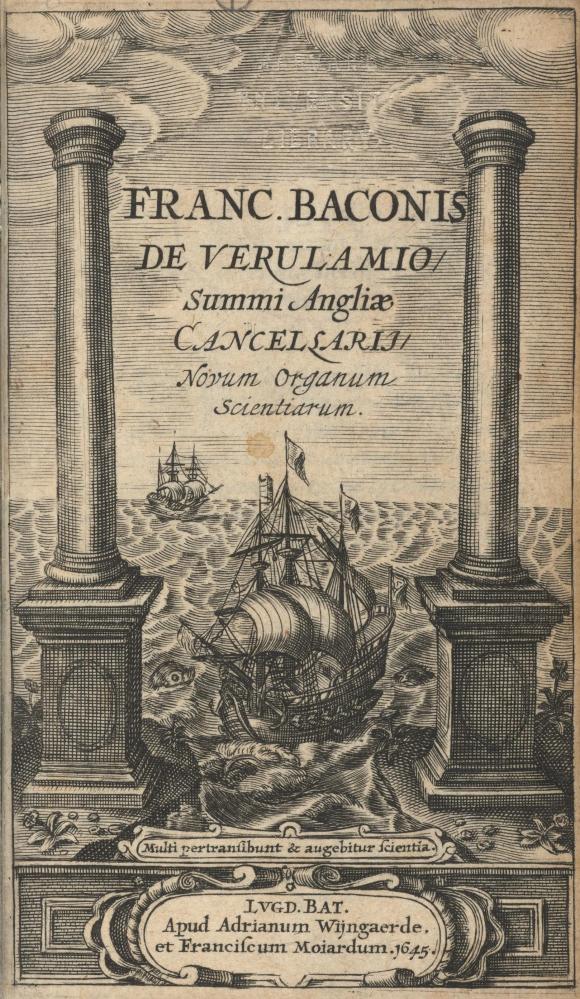
8.) A powerful image from the Renaissance is Francis Bacon’s picture of a ship passing through the Pillars of Hercules into the new world, leaving the known world behind. It echoes older images of the gates of Hercules that have to be passed on a journey of personal development. Bacon’s image depicted a physical journey from a Europe of religious and political conflict, where order was breaking down into the terrible Thirty Years War – out to an open sea and a new world to explore. Today the new spaces for us are of a different kind. The exploration today is within, and it starts from recognising the importance of the quality of being, both in space and in time, and recognising the importance of the natural physical world with which we co-belong; and it also involves thinking about how each of us can realise all that we are capable of. Odysseus in Homer’s epic wandered through islands in the sea and thought his way through to an eventual homecoming in Ithaca. Our journey today takes us to the big challenges of caring for our common home and finding solutions to preserve conditions for biological and human life. Our exploration of history and philosophy can show the narrow bias of some older patterns of thinking, and our exploration of events today can show the uncritical or indeed naïve level of many modern actions in the natural environment. With that knowledge, we have to go deeper, to continually explore to find solutions. Although we live in a world which is so much shaped by hyperproduction, the financial sphere and the real force of technological and military power, there is so much of human existence that is fundamentally defined and resolved by the role and power of words, and so the choice of the right words can help in the path to social renewal.
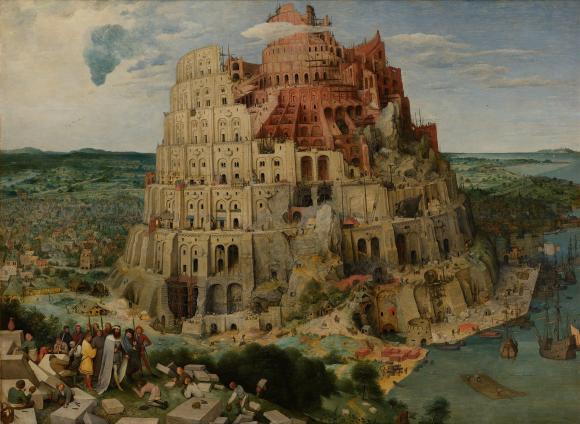
9.) The ancient parable of the Tower of Babel told us how as humans we wanted too much, and pictured how we live as people of the same world in different local cultures and speak different languages. The ancient challenge, which has caused an immense suffering to humanity throughout its history, is also ours: are we able to think the parable that there can be several rooms in a common house, because of which we do not endanger ourselves, because we respect and protect the common home? It has often been described how we have to think globally in terms of one world and one human community, and then act locally within our zone of influence and support to do all that we can to contribute to the global good. The global transformation of thinking and acting to get us through the present combination of crises will require all countries and regions and communities to contribute, each approaching it from their own perspective, and Europe has the history of the Renaissance to draw on to inspire it, and also the heavy responsibility for the damage caused by wars and exploitation of resources and people. The Renaissance itself benefited so much from other cultures, through the transmission of books and scholarship from the East, and it also built on the great 12th-century Renaissance of philosophy and science which was very much the result of a flow of knowledge from the East. Similarly, the great civilisation of the Greeks was a fusion of ideas and knowledge from north, south, east and west. The level of digital communication today means that a new Renaissance in Europe can draw on a wealth of ideas from around the world, and share them in a creative dialogue about solutions for a way ahead for all of us in our common global home.
Text written by Dr Igor Škamperle was considered the main document for discussion at the conference TOWARDS THE NEW EUROPEAN RENAISSANCE which was the part of the The 11th Annual Conference of Europe’s Sciences and Arts Leaders and Scholars It’s About People 2023: Social and Technological Development in Service of Security and Dignity which took place on March 17, 2023.
Andraž Ivšek
Ljubljana, 9 May 2023
I attended the conference TOWARDS THE NEW EUROPEAN RENAISSANCE as a member of the organizing committee.
 In Scientia Veritas