
There are many reasons why the wheel was chosen to be the logo for the European Science Festival. The symbolic meanings of the wheel and of the circle are basically identical, with the exception that the wheel has the additional attribute of movement. The spokes of the wheel symbolically represent the rays of the sun. Identical in symbolism are also the wheel of fortune and the Taoist wheel. According to tradition, the latter does not move, but instead the whole world revolves around it. Like the circle, the wheel is a universal symbol representing omniscience, completeness, basic perfection, the self, infinity, eternity, timelessness, and ultimately God; the circle’s centre then is everywhere, and its surface is nowhere.
But it does represent the idea of movement and thus symbolises the circle of time, the eternal movement of everything movable, like the planets around the sun and the primordial rhythm of the universe. It is also known as the zero in our numbering system and as the circle of life – birth, growth, ageing and death. When it represents the sun, it is masculine power. The sun is our universal father, the centre of all that exists, intuition, knowledge, warmth and brilliance.
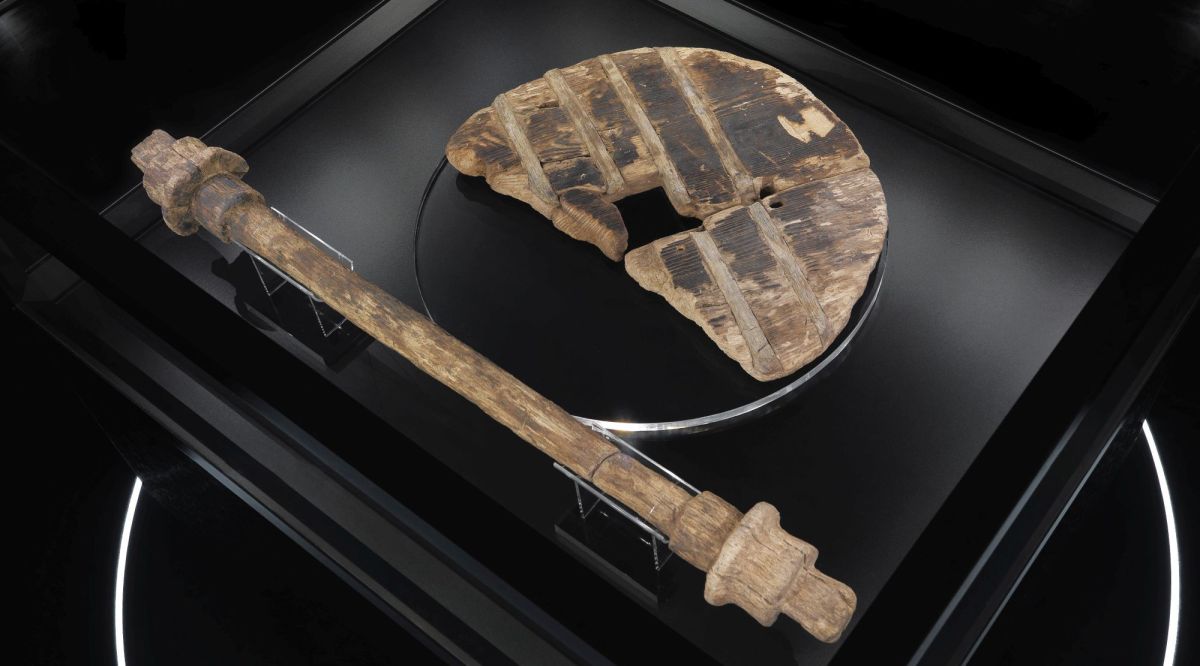
In 2003, archaeologists sampling wood at the colonial settlement of Stare gmajne in the Ljubljana Marshes made a remarkable discovery. They found the remains of a wooden wheel at the bottom of a ditch. It had been damaged by the machinery used to work the landscape, but it was still in excellent condition. Next to the wheel, they found an axle that probably belonged to a two-wheeled handcart (called a ‘ciza’ in Slovenian), a cart that was usually pulled by cattle. In the centre of the wheel there is a rectangular opening for the axle and is made up of two ash panels held in place by four oak wedges. The very construction of the wheel has archaeologists believe that it was the work of a very skilled craftsman who foresaw the shrinking and swelling of the wood, which suggests that the pile-dwellers were skilled in the construction of such wheels.
Irena Šinkovec, museum adviser and senior curator at the Ljubljana City Museum, believes that the technological sophistication, in addition to the age of the wheel, puts it in the very top of the world’s cultural heritage. The axle wheel is dated on the basis of data from dendrochronological research and the radiocarbon method. It is about 5200 years old (exact dating: 3360–3080 BC) and is the oldest wooden axle wheel in the world. It has been preserved by the wet soil, which allows for stable conditions, while the lack of air slows down its deterioration.
The invention of the wheel was undoubtedly one of the most important inventions that radically shaped the development of mankind, it is the foundation of human civilisation and culture, and it was a great stimulation for progress. Nothing this advanced was invented for a thousand years after it.
The first wheel is said to have been used in the pottery trade; it enabled pottery vessels to be made more quickly. It greatly accelerated the transport of heavy loads and the mobility of people. The earliest wheels, dating back to the fourth millennium BC, were solid discs of wood. Later, water wheels made it possible to pump water. In the early 16th century, many ideas for the use of the wheel, unimaginable at the time, were sketched by the genius Leonardo da Vinci. Many of these were realised a century later.
The first wheels were used in Mesopotamia, and from there they are thought to have arrived in Europe. The fact that the inventor of the wheel has not yet been found and quite possibly never will be, and that academics believe that there are several theories about the simultaneous invention of the wheel in several places at the same time, in Europe of the time or elsewhere, only points to the basic quality of science – that science is for all and by all, and for the benefit, despite its dangers, of all. If you recovered from a sore throat because you took an antibiotic, if you ever kicked a bad habit because you listened to a psychologist’s advice, if you overheard the “advice” of an acquaintance from the pub who is an avid user of online videos and social networks, and decided to get vaccinated to help stop the pandemic that has already killed, directly and indirectly, over a million people, if you are reading this on a computer tablet, then you are, willy-nilly, a science user.
One of the main objectives of the European area policy is to conquer and raise awareness of open science. This means that every non-scientist, teacher, politician and journalist can freely access scientific information and verify it.
Andraž Ivšek
Ljubljana, 16 August 2021
 In Scientia Veritas